


Article
Marketing, UI/UX Design
The Blueprint Problem: AI’s Lack of Empathy Creates Broken UI
Posted on November 18, 2025
By Kalyn DeHaven
October 22, 2026
Imagine hiring a contractor to design your new office building.
He’s read every architecture book ever published. He can talk your ear off about tensile strength, load-bearing walls, and airflow dynamics. The blueprint he hands you looks impressive — clean, precise, and full of all the right jargon.
But when construction begins, reality hits: the doors open into walls, the windows face hallways, and there’s a staircase that leads to nowhere. It feels a bit like getting lost in M. C. Escher’s “Relativity”.
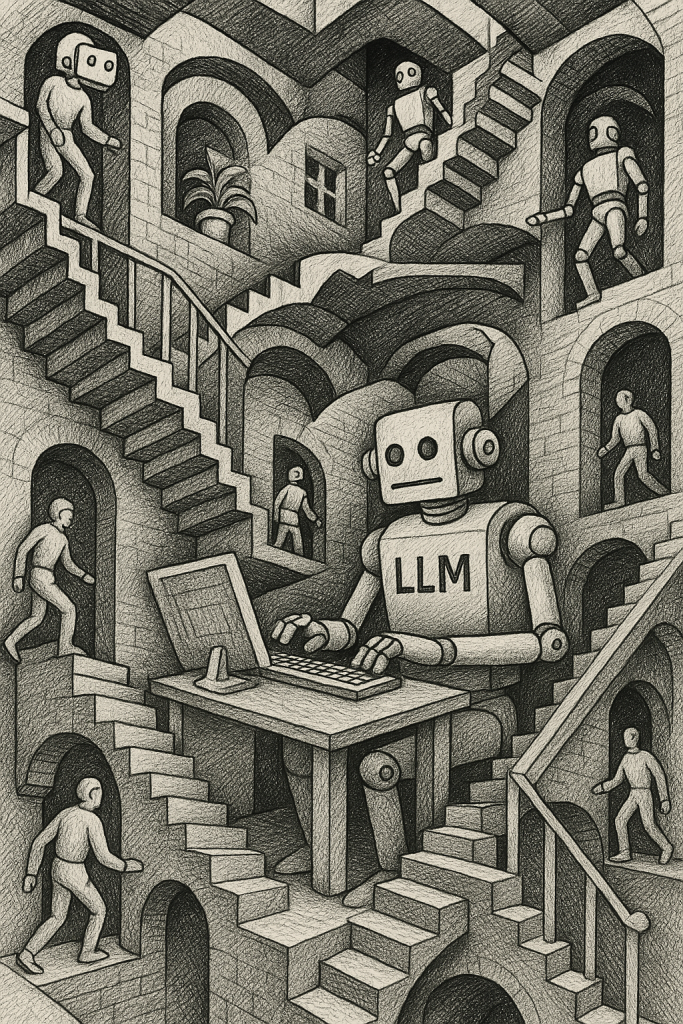
Large Language Models (LLMs) like ChatGPT are trained on words, not experiences. They’ve read everything but lived nothing. They’re remarkable at reproducing the language of design but not the logic or empathy that makes a design work.
At KDG, we’ve spent years exploring how AI fits into the creative process — where it helps and where it hurts. And we’ve seen the same pattern emerge across industries: LLMs can accelerate creation, but they can’t replicate comprehension.
They can build the blueprint. But they can’t build the building.
LLMs Think in Words, Not in Workflows
To understand why, it helps to know what LLMs actually do.
These models don't "design" in the human sense. They don't make decisions, hold preferences, or anticipate behavior. They predict text, one word at a time, based on statistical patterns from everything they've read.
When you ask an LLM to design a user interface, it isn't considering accessibility, hierarchy, or task flow. It's not imagining how a person feels moving through the design. It's generating something that sounds like good design.
For instance, if you prompt it to create a checkout page, it might respond with:
"A clean layout with a billing form, a cart summary, and a big blue 'Buy Now' button."
Sounds reasonable… until you actually try to use it.
Where do you enter a promo code? How does the form handle invalid data? What's the tab order for keyboard navigation? Is "blue" accessible for color-blind users?
AI can't reason about these details because it doesn't think in flows. It doesn't anticipate error states or design for human imperfection. Regardless of how well it may be prompted with the indicated issues or considerations, AI will still struggle to build a useable checkout page.
Good UX, on the other hand, starts with imperfection. It expects confusion. It plans for hesitation. It builds systems that gently correct mistakes rather than punish them.
That's why interfaces designed by AI tend to describe usability rather than deliver it.
When the Blueprint Fails the Building
In practice, AI-generated design tends to fail in predictable ways.
The typography might look sleek, but the contrast is too low. The layout might seem balanced, but it breaks instantly on mobile. Icons are mismatched, interactions are inconsistent, and the "flow" — that invisible thread guiding users from one step to the next — doesn't exist.
It's all surface, no substance.
We've seen this firsthand at KDG. A company once came to us proudly showing off an AI-generated prototype for their new product portal. It looked polished — gradients, shadows, modern buttons — until we started testing.
Users couldn't tell which buttons were clickable. The sign-up form asked for the same information twice. The navigation didn't reflect how people actually thought about the product.
The company's marketing team had done everything right — SEO, ads, social — traffic was strong. But once users arrived, confusion took over. They left before ever seeing the product's true value.
That's the silent cost of treating AI as a designer: a beautiful door that no one can open.
AI Doesn't See People — It Sees Patterns
The best designers don’t think in pixels. They think in people.
They ask:
- Who is trying to use this?
- What are they trying to achieve?
- What’s standing in their way?
LLMs can’t ask those questions. They can only mirror existing answers. That’s why AI-generated design often amplifies the same biases and bad habits already out there. It doesn’t know what’s right, it only knows what’s common.
This lack of human perspective is what separates automation from understanding.
When fpPathfinder, a leader in financial planning tools, approached KDG, their challenge wasn’t lack of data or functionality. Their problem was empathy. Advisors were landing on their platform but getting lost in an interface that spoke in features, not in feelings.
By observing real user behavior through heat and click maps in Pagesense and simplifying the experience to match natural decision-making patterns, our team turned frustration into flow. The result? Higher engagement and deeper trust from the users.
That’s something AI can’t generate because it can’t feel the difference between friction and delight.
What AI Is Good At
Of course, this doesn't mean AI has no place in design. When used correctly, it can be a powerful partner and a smart assistant that helps designers move faster and focus deeper.
At KDG, we've found LLMs helpful for:
- Ideation: Generating first-draft copy for CTAs, page intros, or onboarding steps.
- Research: Summarizing transcripts from user interviews or feedback surveys.
- Analysis: Spotting sentiment trends in support data or reviews.
- Exploration: Brainstorming alternate content structures or naming conventions.
AI can accelerate thinking, but it can't replace judgment.
It's great at creating a starting point, not a stopping point.
Think of AI as your assistant architect: it can outline the materials, summarize the code, and even sketch the façade. But when it comes to knowing that a hallway needs to feel safe, or that a door should open to a welcoming view, that still takes a human.
Why Human UX Still Wins
Human-centered design thrives on empathy, iteration, and emotion — three things AI fundamentally lacks.
When a designer reviews a prototype, they don’t just ask “Does this look good?” They ask, “Does this feel good? Does this flow make sense? Would I trust this brand if this were my first impression?”
Those questions are built on experience and the thousands of subconscious signals we pick up in real life and translate into digital behavior. LLMs don’t have that lived experience. They can’t sense tension or relief. They don’t understand the joy of completion or the frustration of failure.
That’s why, for all the promise of AI, the most impactful design work is still deeply human. Understanding people and solving for their needs far outweighs mere pixels or prompts.
At its core, good UX starts with interaction. The interface comes later. For business leaders, this is where the rubber meets the road. The lure of AI-powered design is multi-tiered: efficiency, lower cost, faster output, instant ideas. But when those ideas don’t convert, the cost becomes clear.
A broken user experience doesn’t just hurt usability, it damages your credibility. It tells customers, subconsciously, “This company doesn’t get me.” Once that impression forms, it’s hard to undo.
Rebuilding trust is far more expensive than building it right the first time.
AI-generated designs are confident but careless, lacking the empathy that using a human would facilitate; all of which leads to design with indifference. When your brand reputation is on the line, indifference is the most dangerous trait of all.
sgsg
The Future: AI Partnership, Not Replacement
There’s a middle ground and it’s the one KDG is most excited about.
AI as a partner for designers, not a replacement. It handles the mechanical so humans can focus on the meaningful.
Used wisely, LLMs can:
- Draft documentation and technical copy.
- Generate multiple layout variations for early brainstorming.
- Identify recurring user pain points in feedback data.
They free creative teams from repetitive work so they can spend more time refining what matters — experience, trust, and emotion.
As one of our UX strategists puts it:
“AI can tell you what users said. It takes a person to hear what they meant.”
The Takeaway
LLMs can build blueprints — fast, detailed, and sometimes even beautiful.
But they can’t imagine themselves walking through it and experiencing the necessity of each part.
They don’t know what it’s like to tap a button in hesitation or scan a screen in confusion. They don’t know what it feels like to trust a brand enough to click “Buy.”
They don’t know that understanding and empathy is the invisible architecture of every great digital experience. That great design is formed on consideration and connection.
So, experiment with AI. Let it accelerate your process and draft the blueprint… but let the humans make sure the door opens the right way.

As AVP of Design & Marketing at KDG, Kalyn brings a unique perspective to every project she tackles. She is dedicated to creating intuitive digital experiences that help organizations work smarter and better serve their customers. Whether she's leading a custom software initiative, optimizing a website, or developing a digital strategy, she takes the time to understand each client's goals, users, and unique challenges.

