


Article
Marketing, UI/UX Design
The Impact of Artificial Intelligence on SEO for Businesses
Posted on July 21, 2025
By Caitlin Nelson
October 22, 2026
Artificial Intelligence (AI) has rapidly ascended from a buzzword to a core driver of technological change across multiple industries and nowhere is this more evident than in Search Engine Optimization (SEO). AI’s influence is reshaping strategies, tools, and success metrics. Every day the rules of the digital visibility game are being rewritten and for companies aiming to thrive online, understanding AI’s effects on SEO and adapting accordingly is not just advantageous—it is essential.
Overview
How AI is Affecting Search User Behavior
Ten years ago a user’s online search for local pizza may have been just that: “local pizza.” The internet was a smaller place and the search engine algorithms weren’t nearly as fine-tuned as they are today. Choices were fewer, simpler, and the user’s manual search experience a lot more labor intensive. Today users are speaking to their smart phone AI companions or using Large Language Models (LLMs) like ChatGPT to find what they need.

A modern user’s search might look (or sound) something more like this:
“Find me three options for pizza places within a ten mile radius that have outdoor seating for a party of six where I can bring my dog.”
- RankBrain leverages machine learning to interpret queries, especially those that are ambiguous or have never been seen before.
- BERT (Bidirectional Encoder Representations from Transformers) helps Google better understand nuances in language, such as prepositions and context.
- MUM (Multitask Unified Model) is designed to handle complex tasks and understand information across languages and formats.
The implication for businesses? Success in SEO is increasingly about providing holistic, high-quality answers to user needs rather than pursuing technical tricks. Keyword-stuffing on every product page no longer works the way it once did and can actually harm your SEO ranking. Businesses must now dig deeper into their customer personas to understand their many problems and the ways they will go about finding solutions.
So How Has AI Changed SEO?
1. Enhanced Search Algorithms
Search engines now process queries with unprecedented depth. AI models can interpret the intent behind a search, even when the query is vague or oddly phrased. For companies, this means that content must anticipate and address a wider array of user intents, moving beyond simple keyword targeting. Intent can be difficult to nail down with so many variables, but some time looking into Google’s People Also Ask is a great place to uncover a broader spectrum of search examples relevant to your content and product.
2. Voice Search and Conversational Search Optimization
With the rise of AI-powered voice assistants like Siri, Alexa, and Google Assistant, voice search has become a critical SEO frontier. Voice searches and the rising use of AI Large Language Models (LLM) tools like ChatGPT and Perplexity tend to result in conversational and long-form search prompts. With more specificity comes higher quality results, so users are also applying this behavior to normal search engines. This shift in behavior means companies need to optimize content for natural language, featured snippets, and long-tail keywords.
To note: Google Search Console is not yet able to track conversational queries and the traffic they bring, creating a blind spot in your analytics reports. If you’re seeing a rise of high-intent users without correlating keyword metrics, it is likely due to this.
3. Image and Video Search Optimization
AI enables advanced image recognition and video understanding, letting search engines “see” and index multimedia content. By using AI-powered image alt text generators, video transcript tools, and schema markup, companies can make non-text content discoverable and accessible in search results. Not only is this keeping your site ADA compliant, but it’s allowing a variety of AI models and engines to better understand the content your site has to offer. This clarity helps rank your content above other sites that may be lacking.
4. AI Search Overviews & Zero-Click Answers
This new convenience of AI search responses for users has become a growing issue for website traffic. AI Overviews and LLMs offer quick, “zero-click” answers compiled from result sources, providing the user’s solution without any further action required. For AI Overviews, these citations are typically pulled from the sites ranking in position 12 or higher in the organic search results. In LLMs like ChatGPT and Perplexity, this information is pulled from Bing search results (not Google!) – so be sure your website is also indexed with Bing.
When your site shows up in these AI responses and overviews as a citation, it counts toward link impressions but often garners no clicks. What does this mean for businesses? Clicks are down while impressions are up and your data ends up looking like a crocodile’s mouth. It’s a growing trend webmasters are seeing and have dubbed “the great decoupling.”
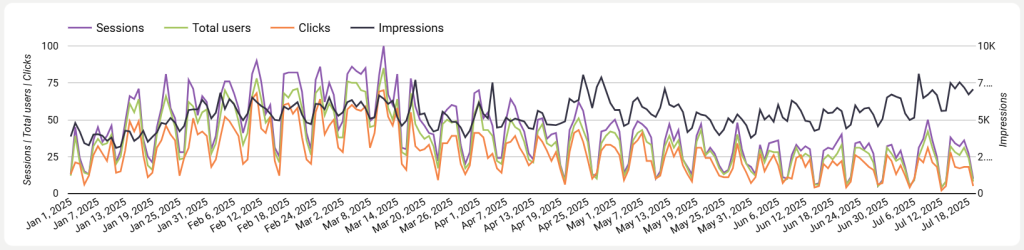
But it’s not entirely bad news. Data and research by ahrefs.com shows that while AI Overviews and LLM answers may be tanking click rates, the users that do click through are 23x more likely to convert when compared to traditional organic search visitors. Leveraging target-refined content and effective Calls to Action (CTA) within your site has never been more important.
5. AI Pulls Real-Time Data From Online Communities
As of 2024, Reddit announced new partnerships with Google and OpenAI (owner of ChatGPT). Reddit is an expansive online hub for communities of just about every topic you can imagine. Not only did these new partnerships help users of AI tools like ChatGPT and Google AI discover Reddit communities relevant to their queries, but Reddit’s Data API is helping to train AI on authentic human conversations.
You may even see when testing long-tail query searches on Google or asking ChatGPT to find resources on topics related to your business that it’s actively pulling search results found in Reddit. Relevant Reddit threads will often be one of the first results you see after the Google AI Overview.
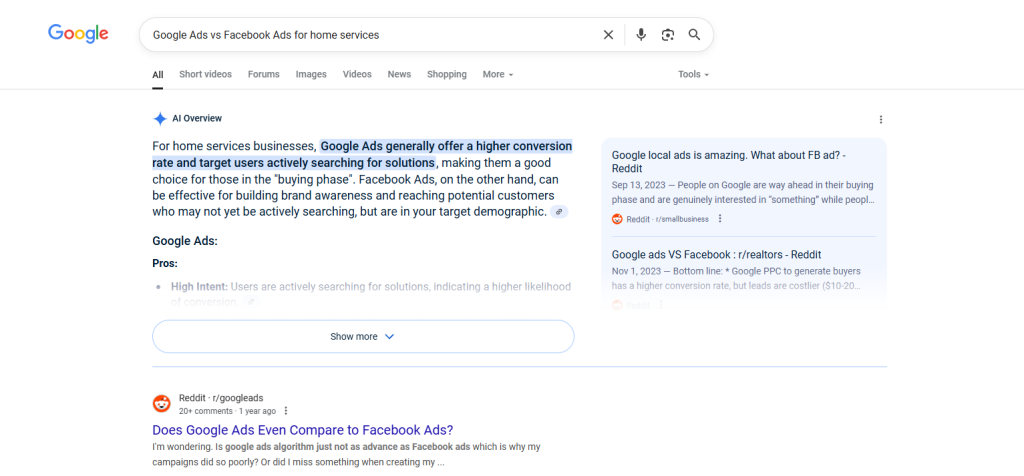
For businesses and advertisers, this means further opportunity to be relevant in the current AI search landscape. Conversations involving your business or company could already be happening – anything from users sharing reviews and testimonials to competitor comparisons. This is the sort of data AI will be looking for when a search query comes along in your subject matter. Getting involved in conversations on Reddit offers businesses a chance to stay relevant and get in front of key audiences, but it should be done with tact and care. Reddit users prioritize authentic, natural conversation, and so do the AI bots trawling the data.
Google AI also pulls data, specifically for its AI Overviews, from another community called Quora, a U.S.-based question-and-answer website and online knowledge repository. It serves as a digital community for people to share information, opinions, and experiences where users can ask and answer posted questions, follow topics, and questions of interest. Due to Quora’s reputation for expert-driven, long-form content it has become a valuable resource for Google’s AI to draw from.
If you want to sell on Reddit or Quora, consider their paid ad options. Otherwise, these spaces are best used for solidifying authority in your industry through thought-leadership and honest interaction—not sales talk.
What is GEO?
GEO stands for Generative Engine Optimization which encapsulates optimizing your content to perform well in AI generated responses provided by AI tools like Google SGE (Search Generative Experience), Bing Copilot, ChatGPT, and Perplexity AI. It’s difficult to fully define any rules simply because these tools are new and constantly evolving. Each AI bot behaves differently, prioritizes uniquely, pulls content from differing sources, and updates their algorithms based on a broad variety of their own proprietary data.
GEO focuses on informational content structured for AI digestion and reuse and uses content clarity, factuality, source trust, structure, and citations as part of its ranking determination. Polishing your content strategy so that it is structured and refined to be LLM-friendly is the new layer that GEO brings to SEO. The best strategy today is to maintain use of traditional SEO principals in building well-structured and optimized content to provide the foundation from which generative engines draw upon.
But there’s no need to shift or ditch your current SEO strategy entirely. Despite the growing use of generative AI for search, data shows that AI tools only drive around 1% of website traffic while search engines like Google still drive 99%.
Simply put, generative engines are a long way away from taking over traditional search engines. SEO is here to stay (for now).
Is SEO Still Relevant in 2025?
While AI is changing the landscape of how people find solutions to their needs, the key takeaway here is not to completely ditch traditional SEO strategy and approach. AI search still relies almost entirely on the foundational SEO principles and your biggest doorway for users to find you online is your website. Good SEO practices and good content are still necessary, relevant, and still work.
Here are a few ways to evolve your current SEO strategy for AI:
- Build out your users’ personas and intent and do the research to anticipate their evolving needs.
- Prioritize website content that genuinely solves problems, creates authority for your brand, and offers original insights.
- Maintain clear, structured markup (FAQs and schemas) as well as ADA compliance across your site.
- Break down your customer digital journey and ensure your site’s UI/UX is clean, efficient, and effective for mobile, desktop, and tablet users.
- Make sure your website has been indexed by Bing to make its content available to LLMs like ChatGPT and Perplexity.
- Ensure you’re taking steps to get featured on quality, third-party sites to build credible backlinks.
- Get your business properly featured on Google Business Profile and keep it up-to-date and consistent with information across your site and socials.
- Consider getting involved in other popular online communities and creating direct, authentic engagement with consumers in places like Reddit and Quora where AI actively pulls data for search results.
- Stay informed on the latest algorithm changes and AI model updates so you can adjust your strategy as-needed.
Conclusion
The landscape of search behavior may be evolving but the inarguable foundation of your site’s health and search ranking is a partnership of good SEO content and practices alongside good UI/UX. Content that ranks well in traditional search will rank well for AI search. Keep focused on the fundamentals of creating content that is useful, building authority in your industry, and nurturing trust with your constituents. Quality content that serves real people will never go out of style or priority.

Caitlin Nelson is a skilled marketing professional with a passion for creativity, communication, and strategic planning. With years of marketing experience under her belt, she brings a wealth of expertise to clients and KDG.

